Resources
Take the idea with you
Free downloads of the educational cards, diagrams, and infographics featured on @SOCurious_PhD. Each one summarizes published research and names the researchers behind it.
Gaslighting as a social process
Work cited
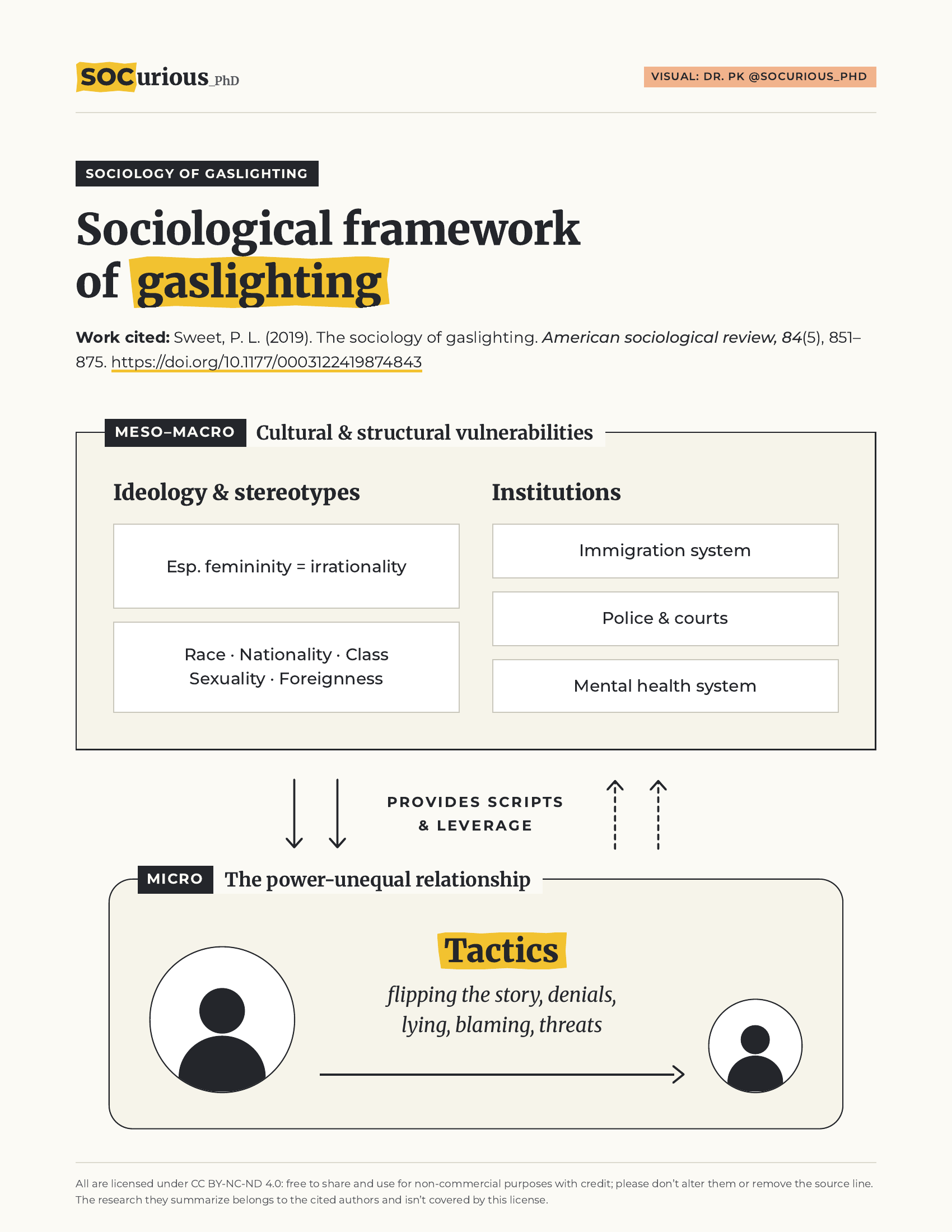
Gaslighting is usually treated as a psychological problem between two people. The sociologist Paige Sweet argues it works because of wider inequalities. Stereotypes, like the idea that women are “too emotional”, make one person’s account easier to dismiss.
The term comes from Patrick Hamilton’s 1938 play Gas Light and its 1944 film, in which a husband dims the lights and then insists his wife is imagining it. Though you’ve probably seen it all over popular culture since!
This handout illustrates how gaslighting tactics within the micro-interactions of a relationship draw upon, and reinforce, biases and imperfections in our institutions.
Episode: Why gaslighting works
A perfectionist’s attempt at being good enough
The economic principle of marginal costs means every project reaches a point where more input costs more than the improvement it buys. The economist Richard Caves applied this economic thinking to creative work. And Dr. PK applies it to her lifetime recreation of perfectionism.
Work cited
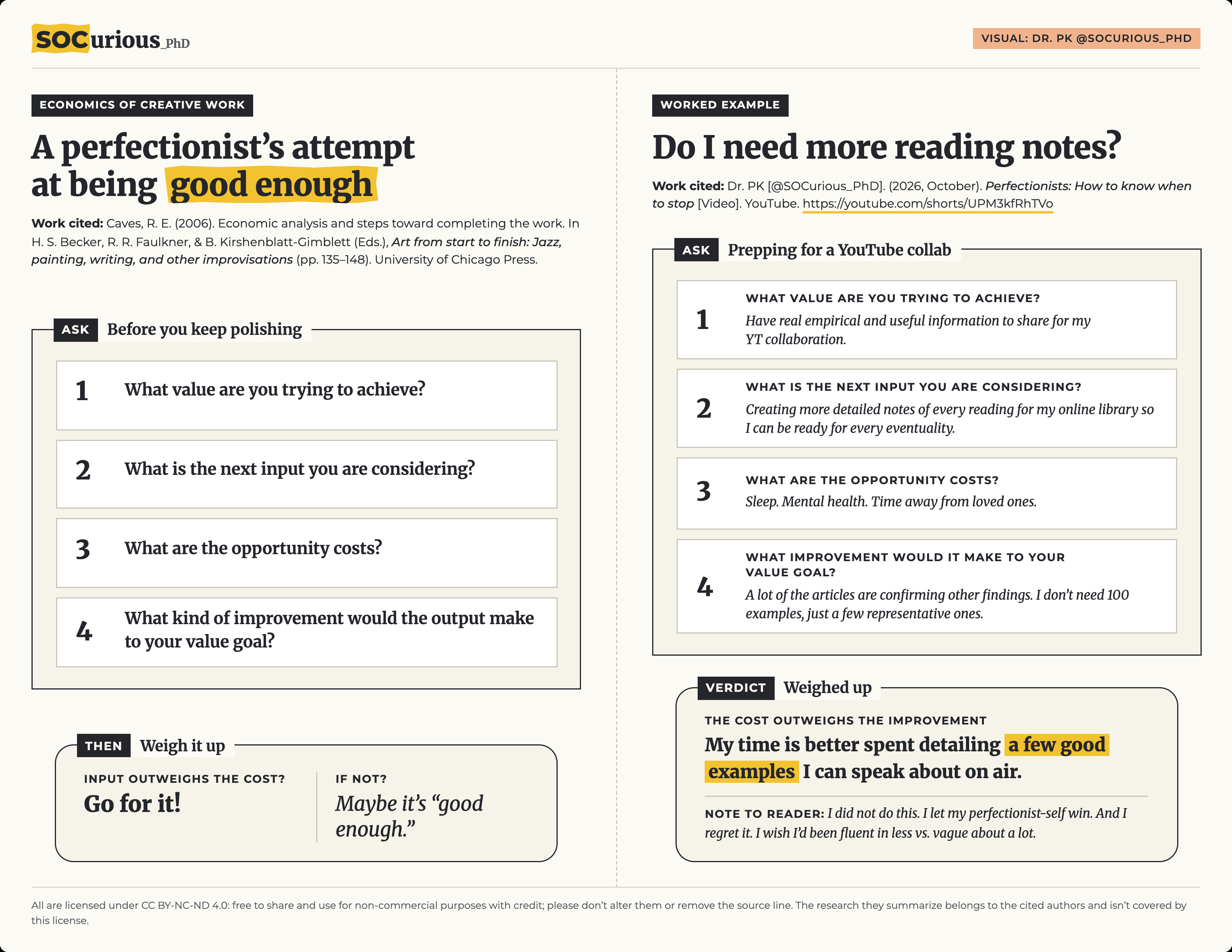
Caves studied how artists, writers and musicians decide a piece is done. His answer is not a feeling. It is a comparison: what you are trying to achieve, what the next input would cost (in time, sleep, money, attention), and how much closer it would actually get you. When the cost outweighs the improvement, the work is finished — whether or not it feels finished.
The card turns that into four questions you can ask before you keep polishing, and a worked example from the channel where the answer was “stop” and the perfectionist ignored it.